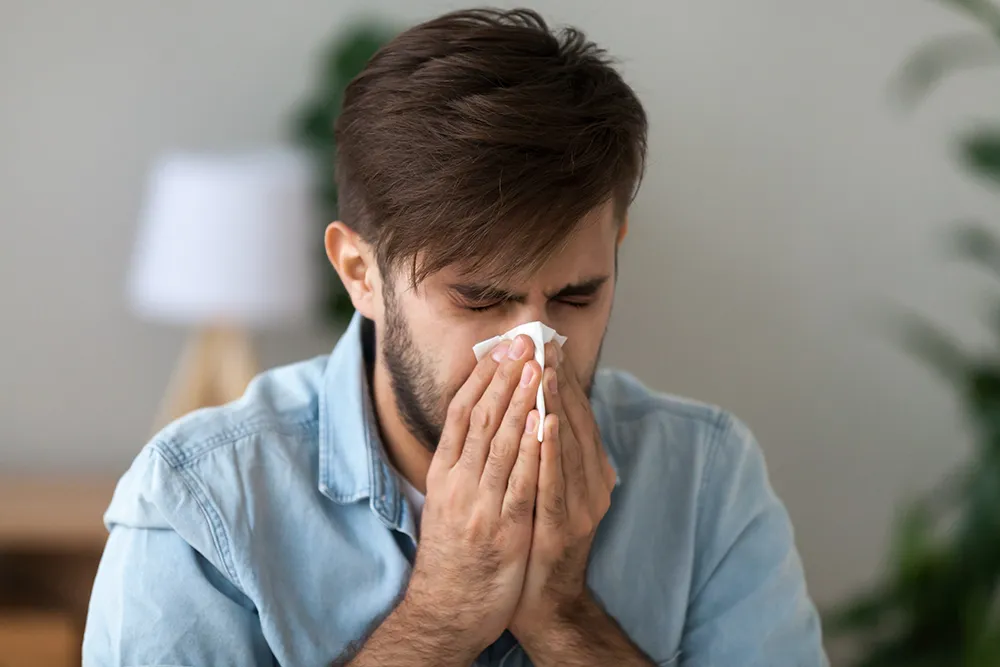
How can you reduce pollen and allergens indoors during hay fever season?
Regularly cleaning floors, carpets and soft furnishings can help reduce the pollen and allergens that enter your home on clothing, hair, footwear and through open windows.
The Pollen Problem Doesn't Stop at Your Front Door
Most people associate hay fever with being outside—sneezing through the commute, watery eyes at the garden, that general feeling of wanting to stay indoors until October.
The issue is that staying indoors doesn’t actually fix it.
Allergic rhinitis, the condition behind hay fever symptoms, affects over 400 million people globally. That’s not a niche problem. And for a significant number of those people symptoms persist indoors, not because of anything they’ve done wrong, but because pollen doesn’t stay outside just because you’ve shut the door.
What actually happens when pollen gets inside
Pollen travels indoors on clothing, hair, footwear, and through open windows and once it’s in, it settles fast. On hard surfaces it’s relatively easy to remove. On carpet, soft furnishings, and fabric it embeds, and that’s where it tends to stay.
The reason it lingers longer indoors than outside comes down to UV exposure. Outside, sunlight and moisture degrade allergenic proteins relatively quickly. Indoors, protected from both, those same proteins can persist on surfaces for weeks or months, long after the outdoor season has officially moved on. Research confirms that allergens can remain in indoor environments for months after the original source is no longer even present.
A national survey of US homes conducted by the National Institute of Environmental Health Sciences found detectable levels of dust mite allergen in 84% of homes surveyed—concentrated most heavily in carpets, bedding, and soft furnishings. Pollen behaves similarly once it settles indoors: it finds the same surfaces and stays there.
Why regular cleaning matters more than people realise
There’s a tendency to treat hay fever management as purely an air quality issue—purifiers, filters, keeping windows closed at peak pollen times. Those things help but surface cleaning is just as important, because the allergens sitting in carpet fibres and on hard floors are reintroduced into the air every time the space is disturbed, someone walking across the room, a window is opened or the heating comes on.
Research comparing carpeted and smooth floors consistently finds significantly higher allergen accumulation in carpet—not because carpet is inherently worse to live with, but because fibres trap particles that a hard floor would simply have swept away. The same act of vacuuming that appears to clean carpet can re-suspend particles back into the breathing zone if the right products and technique aren’t used alongside it.
For hard floors and interior surfaces, dry dusting presents the same problem; it moves allergens rather than removes them. Cleaning products that lift and capture what’s settled, rather than redistribute it, make a genuine difference to how much allergen load actually gets reduced.
The part the cleaning aisle doesn't always communicate clearly
Cleaning for allergen reduction is a different job from cleaning for visible dirt. The particles causing the problem are invisible, present across every surface in a space, and continuously reintroduced from outside. The goal isn’t a single deep clean, it’s consistency, because allergen levels are determined by how much accumulates between cleans as much as by how thoroughly any one clean is done.
This is the thinking behind SCRUBB’s indoor and surface cleaning range—products formulated to do a proper job on the surfaces people actually live and work on, not just make them look clean. Because in the context of allergens, looking clean and being clean are two different things.
Hay fever season tends to get framed as an outdoor problem. For anyone spending the majority of their time indoors, it’s worth treating it as an indoor one too.